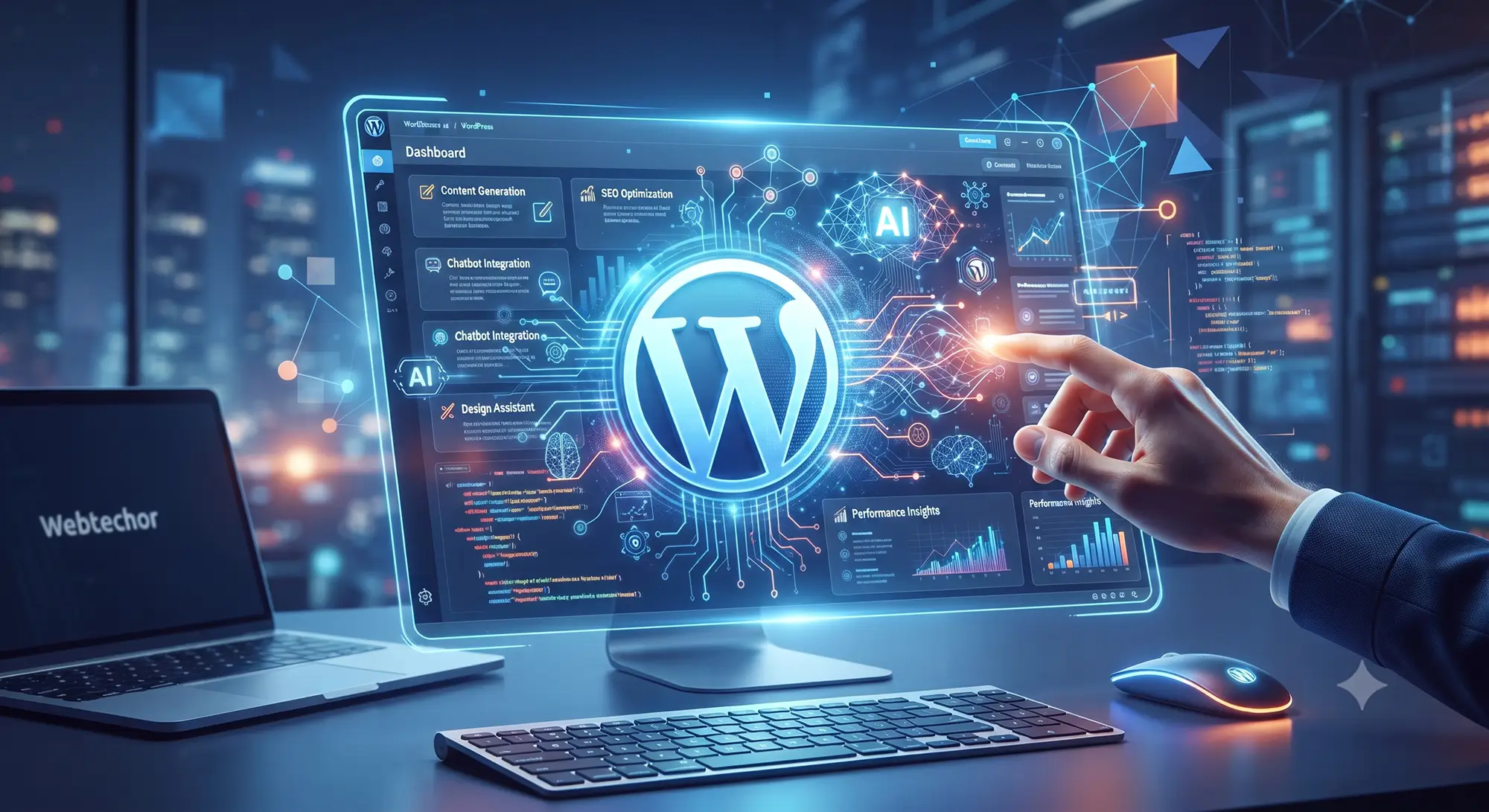
Ai in Word Press: How Artificial Intelligence is Transforming Website Development
Not long ago, building a WordPress website meant starting with a blank page, manually choosing a theme, and writing every line of content yourself. In 2026, however, that process looks very different. Building a website feature now often starts with a single sentence, and AI takes it from there — generating layouts, drafting content, and even suggesting design decisions in seconds.
As a WordPress developer, I’ve watched this shift happen in real time. Clients now arrive with AI-generated references and half-formed ideas already in hand, and they expect faster builds, smarter tools, and websites that adapt automatically to visitors. In this guide, I’ll break down exactly how AI is transforming WordPress website development, and what it means for developers and site owners alike.
AI-Powered Website Building and Design
Perhaps the most visible shift is in how developers actually build sites in the first place. Modern AI website builders can generate a full working site from a single prompt, dramatically cutting down setup time that used to take days. Instead of starting from a blank code file, developers and business owners can now describe what they want, and AI generates working components, layouts, and even entire themes to build on.
Page builders themselves are evolving too. Elementor, for example, has been embedding AI features directly into its builder, allowing users to generate and refine designs without needing deep design expertise. This doesn’t replace the developer’s role — rather, it removes the friction that used to stop people from experimenting and iterating quickly.
AI-Driven Content Creation
Content creation is one of the biggest pain points for website owners, and AI has become a genuine solution here. Unlike older, generic AI writing tools, modern AI systems can understand context, brand voice, and user intent, which allows WordPress users to produce high-quality, consistent content much faster than before.
Beyond just writing new content, AI also helps by:
- Identifying outdated posts and recommending updates based on current trends
- Suggesting improvements to headlines and readability
- Reducing writer’s block by generating ideas and first drafts
- Keeping tone and voice consistent across an entire site
Smarter, AI-Powered SEO
AI is also reshaping how WordPress SEO actually works. Rather than relying purely on manual keyword research, AI-powered plugins can now analyze competitor strategies, optimize keyword placement, and adjust content relevance dynamically to support better rankings.
Some of the most useful AI-driven SEO capabilities in 2026 include:
- Predictive analytics that help identify emerging keyword trends before competitors catch on
- Automated on-page SEO suggestions built directly into the editor
- Voice search optimization, since conversational queries continue to make up a growing share of all searches
AI-Powered Personalization
In the past, only large-scale platforms with big development budgets could offer real personalization. Today, AI puts this same capability within reach of WordPress sites of virtually any size. By analyzing browsing patterns, device types, and interaction history, AI helps websites tailor what each visitor sees, rather than showing the exact same experience to everyone.
For example, a returning visitor might see a different call-to-action than a first-time visitor, based purely on their past behavior. This kind of adaptive experience tends to lead to higher engagement, longer session durations, and, ultimately, better conversion rates.
AI for Accessibility and Performance
AI increasingly catches accessibility issues that are easy to overlook manually — flagging missing alt text, poor color contrast, or confusing navigation structures. As a result, WordPress sites can reach a broader audience while staying aligned with accessibility standards.
On the performance side, AI tools also identify bottlenecks, suggest optimization steps, and even automate parts of ongoing site maintenance — which pairs well with the Core Web Vitals metrics that continue to influence search rankings.
Is AI Replacing WordPress Developers?
This is what most people actually want to know, and the honest answer is no — not in the way many assume. Across every source in this space, one theme keeps repeating: AI acts as a collaborative assistant, not a replacement. It handles repetitive, time-consuming tasks so developers can focus on strategy, customization, and the judgment calls that AI still can’t make on its own.
In practice, this means:
- AI can generate a working starting point, but real customization still needs human input
- AI speeds up production, but strategy and brand alignment still require a developer’s or designer’s judgment
- AI reduces long-term development and maintenance costs, but the actual savings depend heavily on which tools and workflows a team chooses
Final Thoughts
AI in WordPress has moved well past being a novelty — teams now rely on it as a standard part of how they design, write, optimize, and maintain modern websites. From AI-powered builders and content tools to smarter SEO and real-time personalization, the technology is genuinely changing what’s possible for WordPress site owners, regardless of their budget or technical background.
As a WordPress developer, I see AI as a powerful addition to the toolkit rather than a threat to the craft. If you’re curious how AI-powered tools could speed up or improve your next WordPress project, feel free to get in touch.
Frequently Asked Questions (FAQs)
Q1. Will AI replace WordPress developers? No. AI is enhancing developers’ capabilities by automating repetitive tasks, but human input is still essential for customization, strategy, and brand-specific decisions.
Q2. Can AI actually build a full WordPress website on its own? AI tools can generate a working layout, content, and structure from a simple prompt, but most sites still benefit from human refinement for real customization and polish.
Q3. How does AI help with WordPress SEO specifically? AI assists with keyword research, predictive trend analysis, on-page optimization suggestions, and voice search readiness, making SEO more proactive rather than purely reactive.
Q4. Is AI in WordPress only useful for large businesses? No. AI has actually made advanced features like personalization and automated content optimization accessible to small businesses and solo site owners, not just large platforms.
Q5. Does using AI tools in WordPress increase or decrease development costs? It depends on the specific tools a team chooses, but AI often reduces long-term development and maintenance costs by automating repetitive tasks and speeding up production timelines.